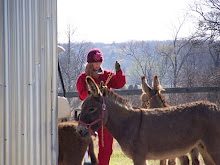
Finally, after raising goats for, what? five years now, I had enough milk to experiment with cheese making. My plan was to milk three goats, with Daughter-in-law's help. It turned out that we got so much milk from just two that I really didn't need the third, so we just let her feed her triplets and left her alone. My milking is limited to how much storage space I have. I filled up my allotted space in the chest freezer, gave several quarts to Nephew (who has returned to Texas, God's country, but is living at his own place now), and two dozen quarts to Daughter-in-law's parents.
We decided to experiment with cheese making using the milk from the last couple of weeks of milking. My cheese making book said to use fresh milk, no more than 48 hours old. So we had to plan ahead, saving a couple of days worth of milk for each project. We started with not-really-cheese-but-yogurt. It looked like a very simple process in my cheese book.
I got my cheese making stuff laid out and ready to go. Cultures, measuring things, book...
cheese vat (which is really just a large double boiler), and thermometer.
We started with two quarts of fresh milk.
Put it in the vat and heated the milk to 115 degrees. We used some store bought greek yogurt as a starter culture, which is stirred into the warmed milk.
Then the yogurt-to-be must be incubated for 6-12 hours, at a temperature of 100 degrees. We decided to keep it warm in a crock pot, which seemed like a great idea at the time, but turned out to be not such a great idea. I had to check it constantly and adjust the temperature...low, off, high, keep warm...none of the setting would keep a constant temperature. We read later that putting it in the oven works well for some people. I'll try that the next time.
We thought it was a big fail because it looked so milky even after ten hours of incubating. But, after being refrigerated, it did set up and we were happy to find that we actually were marginally successful at making the yogurt. Daughter-in-law let hers strain in cheesecloth, which gave it a thicker consistency.
Next up was an attempt at mozzarella. We started with one gallon of fresh milk, added dissolved citric acid to it and then heated to 88 degrees. Then we added diluted rennet and let it sit for fifteen minutes to coagulate.
When it's coagulated enough, the test is dipping a finger in to see of the curds break cleanly. Daughter-in-law did the honors and it did, indeed, break cleanly.
Beginning to cut the curds carefully. This is nerve wracking.
It's cut into squares and then an attempt to cut them underneath the surface.
This is the best we could do. We were pretty pleased with ourselves to see our little squares of curds floating in the whey.
Our satisfaction was short lived because the curds, which are supposed to stay in nice little square shapes, quickly became a big sticky glob as we followed the instructions to slowly bring the temperature to 108 degrees and hold for 35 minutes. We were supposed to stir gently to keep the curds from matting. I'd say it's too late for that.
We strained the cheese in a colander and then "heat treated" it. We were supposed to be able to "work" the curds with our spoon, mixing them with a little salt. But it was pretty difficult to "work" a little unwieldy lump of spongy mozzarella.
Oh well. It wasn't a complete fail. A little on the dry side, but we did end up with something mozzarella-like, bordering on parmesan. And it tasted OK.
On to the ricotta. Super easy.
Again, we started with one gallon of fresh milk. We heated the milk in our cheese vat to 185 degrees, removed it from the heat and added organic apple cider while stirring. The tiny curds formed quickly.
Poured into a colander lined with cheese cloth and let it drain for 30 minutes.
Voila! Lovely ricotta.
I see lasagna in my future.
What surprised me the most about this cheese making experience is that it takes so much milk to make so little cheese. A gallon of milk yielded just two little pats, maybe a cup each, of mozzarella and it took a gallon of milk to make about two cups of ricotta. I felt so wasteful pouring all of that whey down the drain. There are things one can make with whey, but it requires fresh whey, so you have to be prepared to start your next project immediately after you've poured off your whey. That's a pretty big time commitment that we weren't ready to make.


 Posts
Posts